
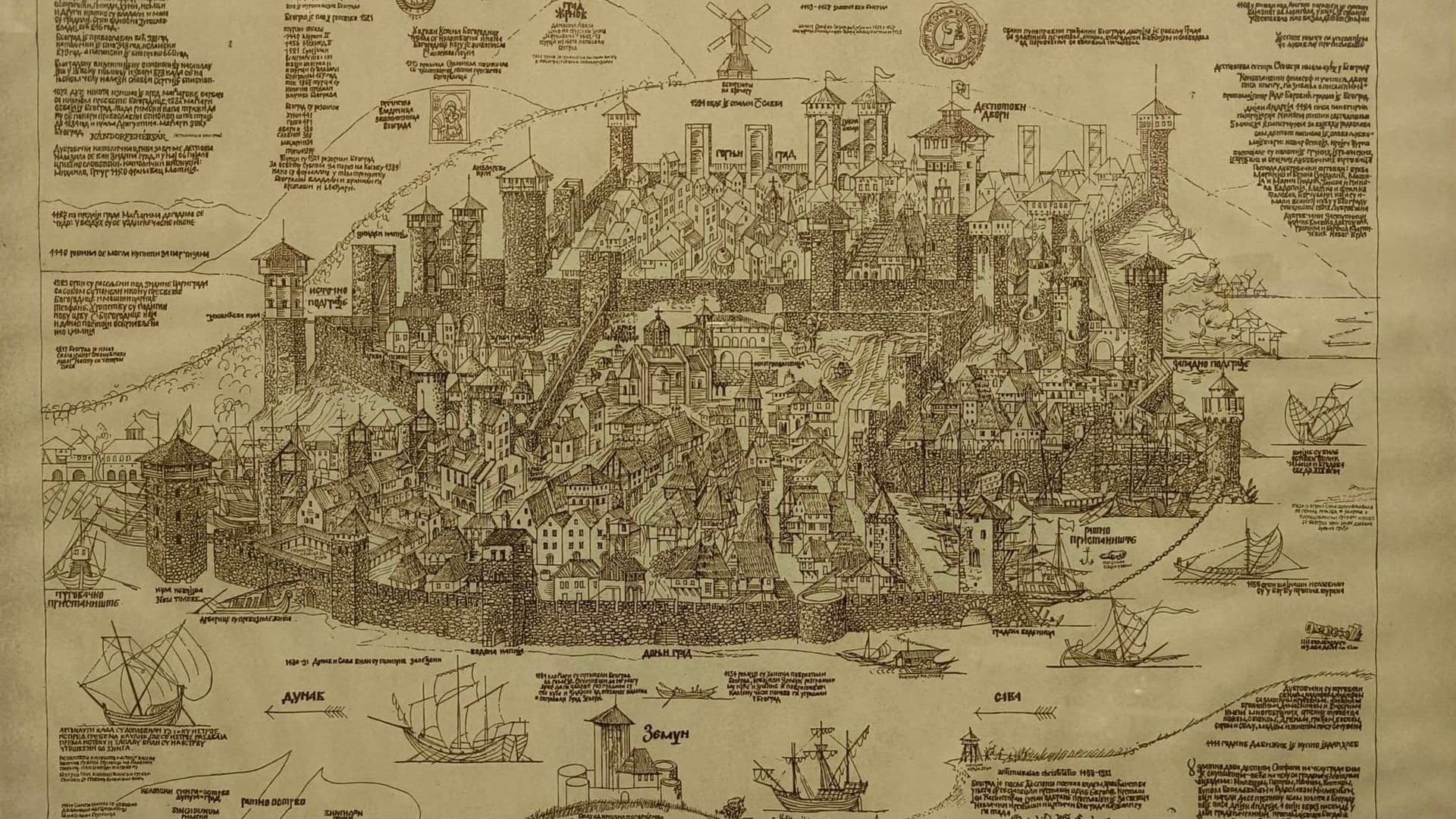
Despot Stefan Lazarević and the Rise of Medieval Belgrade
“Upon my coming, I found the fairest place since times of old, the great city of Belgrade, which by fate had been laid waste and left desolate; and I did raise it anew and dedicate it unto the Most Holy Mother of God.”
With these words, the Serbian medieval ruler Stefan Lazarević proclaimed Belgrade the capital of the Serbian state in 1405. This marked the first time in history that Belgrade became the capital of Serbia. But how did this transformation occur?
The Rise of Stefan Lazarević
Stefan Lazarević was the son of Lazar Hrebeljanović, one of the most powerful Serbian noblemen following the death of Serbian Emperor Stefan Dušan. Owing to his military strength and political influence, Prince Lazar became the leader of the Serbian forces at the famous Battle of Kosovo against the Ottomans in 1389.
The battle proved catastrophic for both sides. Prince Lazar and the Ottoman Emir Murad I were both killed. One of Murad’s sons, Yakub, also died during the battle, leaving the other son, Bayezid I, as the sole claimant to the Ottoman throne. Following Ottoman dynastic custom, Bayezid swiftly returned to secure his succession by eliminating rival heirs.
To strengthen political ties with Serbia, Bayezid married Stefan’s sister, Mara Lazarević, who was highly respected at the Ottoman court. As an Ottoman vassal, Stefan participated in several military campaigns on behalf of the empire.
One of the most significant was the Battle of Nicopolis, where Ottoman forces defeated a major Crusader army. During the battle, Stefan and his knights reportedly captured the banner of Sigismund of Luxembourg.
Stefan later fought in the Battle of Ankara against the forces of the Central Asian conqueror Timur. The Ottoman army suffered a devastating defeat. According to historical tradition, Stefan broke through enemy encirclement several times in an attempt to persuade Bayezid to retreat from the battlefield. Bayezid refused, was captured by Timur, and later died in captivity.
Chroniclers recount that Timur referred to the Serbian cavalry as “black-clad warriors” or “mad dervishes” because of their fierce charges and disciplined combat style. Impressed by their military prowess, Timur allowed the Serbian forces to withdraw freely from the battlefield.
The Despot of Serbia
On his return journey, Stefan visited Constantinople, where Emperor John VII Palaiologos, ruling in the name of his uncle Manuel II Palaiologos, granted him the Byzantine title of Despot. In the Byzantine hierarchy, this was one of the highest court titles, second only to that of emperor.
Soon afterward, Stefan shifted his political allegiance from the Ottomans to the Kingdom of Hungary and became a vassal of King Sigismund. As part of this alliance, Sigismund granted him Belgrade, which would soon become the political and cultural center of medieval Serbia.
The Golden Age of Medieval Belgrade
The years of Stefan’s rule over Belgrade may be regarded as the city’s greatest renewal and most intensive development during the Middle Ages. Through generous privileges and economic incentives, Stefan attracted both local inhabitants and foreign merchants and craftsmen, many of whom established permanent colonies within the city. Among these settlers, merchants from Dubrovnik were especially prominent.
Thanks to these policies and the rapid influx of population, Belgrade developed into one of the principal centers of trade between the Kingdom of Hungary — and, through it, Central Europe — and the Balkans.
Numerous structures essential to urban life were constructed during this period: Orthodox and Catholic churches, bakeries, watermills, harbors, customs houses, and marketplaces, including a specialized fish market. Stefan, renowned as a patron of culture and learning, also gathered scholars, writers, and educated men from Serbia and neighboring lands at his court, transforming Belgrade into a major center of Serbian literary and cultural life.
Expansion of the Belgrade Fortress
During Stefan’s reign (1403/1404–1427), Belgrade Fortress underwent extensive reconstruction and expansion. The total defended area increased nearly tenfold, from approximately 1.6 hectares to more than 15 hectares.
The first phase included the restoration and strengthening of the old Byzantine fortifications. The Byzantine castel was reinforced with two square towers along the southeastern wall, while a princely court and a massive donjon tower — today known as the Nebojša Tower — were constructed within the fortress.
The Serbian suburb below the fortress was also fortified with additional towers and walls extending toward the River Sava, creating a significantly larger harbor.
This was followed by the construction of the Upper Town, protected by double walls, a counter-escarp system, and a dry moat. The complex had an approximately rectangular layout measuring around 300 by 160 meters and covered roughly 4.2 hectares.
The final phase involved the construction of the Lower Town walls, stretching from the Upper Town toward the Danube and continuing along the riverbank to the fortified western suburb. These defensive works enclosed an area of approximately 9.5 hectares, including the commercial district, harbor facilities, and the complex of the Metropolitan Church.
Stefan Lazarević’s Legacy
Beyond his military and political achievements, Despot Stefan Lazarević was also a writer, poet, and reformer. During his reign, Serbian fresco painting reached one of its artistic peaks, while the Morava architectural style flourished throughout the Serbian lands. He introduced legal reforms and contributed significantly to the development of Serbian literary culture.
Today, many traces of Stefan’s Belgrade still survive. The walls he built remain part of the Belgrade Fortress, along with the famous Despot’s Tower. Archaeological remains of the Metropolitan complex can still be seen in the Lower Town. The city also commemorates him through monuments and streets bearing his name.
In many ways, the foundations of medieval Belgrade — political, cultural, and architectural — were laid during the reign of Despot Stefan Lazarević, one of the most remarkable rulers in Serbian history.