
The Monument of Victory: History, Controversy and Symbolism of Belgrade’s Most Famous Monument
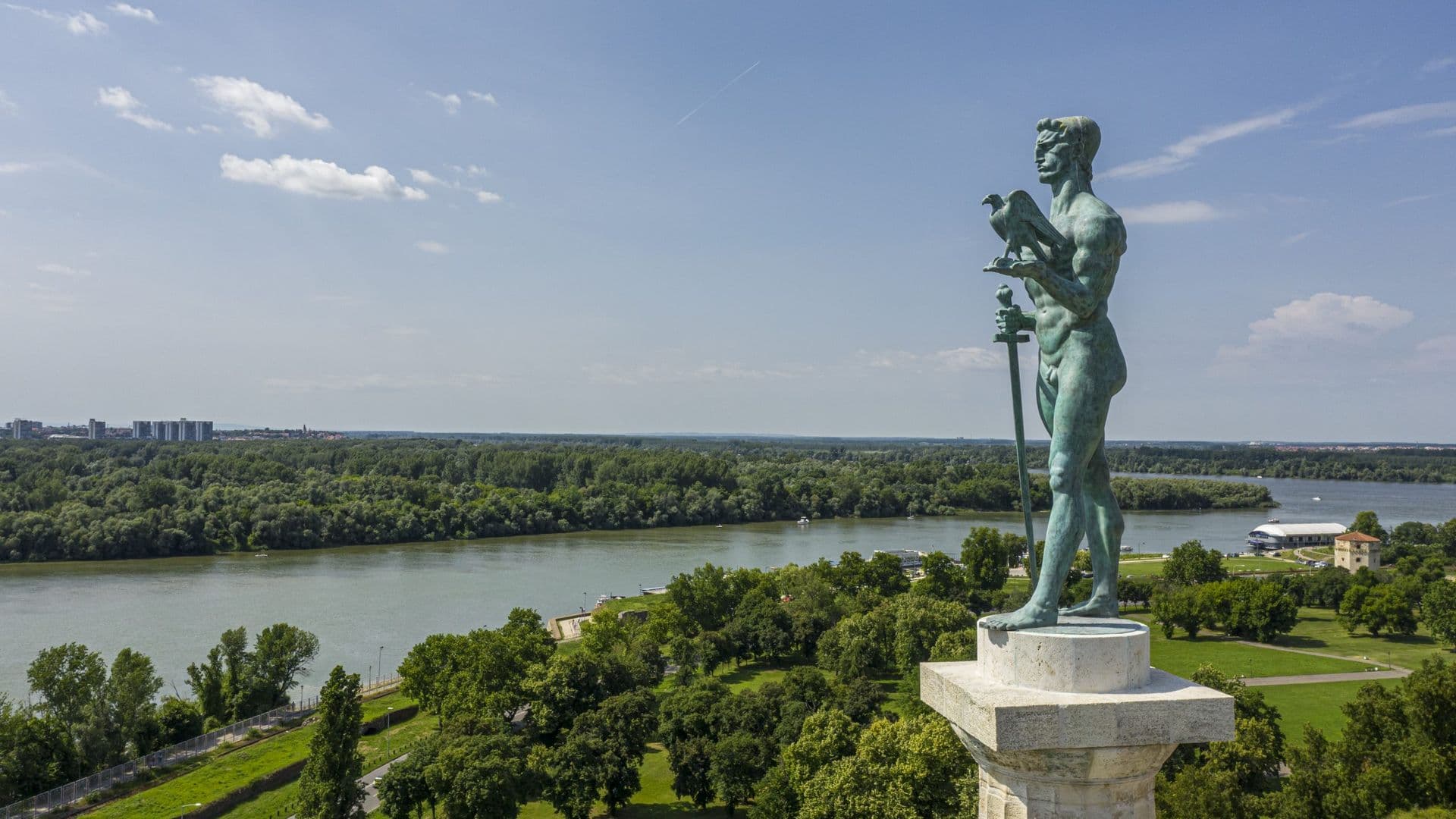
The Monument of Victory is one of the most recognizable symbols of Belgrade and one of the city's most prominent landmarks. Standing on the Upper Town of Belgrade Fortress, high above the confluence of the Sava and the Danube, the monument has become an inseparable part of the city's identity. It is something you shouldn't miss during your stay in the city. But the story of it is much more interesting.
The Idea Behind the Monument
The origins of the Victor date back to 1913, following the Second Balkan War. Serbia had emerged victorious from both Balkan Wars, fought in 1912 and 1913. These conflicts resulted in the expansion of the Serbian state and the liberation of territories that had previously been under Ottoman rule and had historical connections with the medieval Serbian state.
The Balkan Wars represented a major turning point for Serbia. The Ottoman Empire was largely expelled from the Balkans, while the territorial ambitions of Bulgaria were defeated during the Second Balkan War. At the same time, however, the military victories came at a significant human cost.
The Serbian government therefore sought to commemorate the victories with a monumental work in the capital of the Kingdom of Serbia, Belgrade. The original concept envisaged a large fountain at Terazije Square, one of the most important public spaces in the city, with a monumental sculpture positioned above it.
The commission was given to Ivan Meštrović, one of the most important South Slavic sculptors of the early twentieth century. Meštrović was already internationally recognized and had strong connections with the cultural and political circles surrounding the Karađorđević dynasty.
He began working on the monument in 1913 and completed the sculpture during the same year. The work was produced in the building of the first modern elementary school in Belgrade, today known as King Peter I Elementary School.
The monument, however, would have to wait.
The First World War and the Hidden Sculpture
The political situation in Europe deteriorated rapidly after the Balkan Wars, and soon it will lead to the start of the World War One.
On July 28, 1914, Austria-Hungary declared war on Serbia, and Belgrade became the first major cities directly affected by the conflict. Great war started on the confluence of the Sava and Danube rivers.
The sculpture was still in Belgrade and was hidden inside the school building. The Austrian occupation forces did not discover it, allowing Meštrović's work to survive the occupation.
Belgrade and much of Serbia remained under occupation from 1915 until the liberation of the country in late 1918.
The end of the war created an opportunity to revive the original plan for the monument. Yet the political and social circumstances had changed considerably, and the sculpture itself soon became the subject of controversy.
The Controversy Over the Naked Victor
In 1920, plans were revived to erect the monument at Terazije Square. The choice of the sculpture, however, provoked strong public reactions.
The central figure was completely naked.
For contemporary Belgrade, this was a controversial artistic decision. Some women publicly objected to the sculpture on the grounds of indecency, particularly because its sexual characteristics were clearly visible. Yet the objections were not limited to women.
Many men also considered the figure inappropriate as a representation of Serbia's wartime victories. Serbian society at the time remained predominantly traditional and patriarchal, and the idea of placing a naked male figure in one of the city's central public spaces challenged prevailing social conventions.
There was also a deeper issue concerning the meaning of the monument itself.
Serbia had suffered extraordinarily heavy losses during the First World War. According to various historical estimates, the country lost 28% of the population, and more than 50% of it's working-age male population. The war had therefore become associated not only with victory and national liberation but also with immense personal and collective sacrifice.
For many contemporaries, a monument dedicated to victory was expected to commemorate the soldiers who had fought and died. A figure in military uniform, carrying weapons, would have corresponded much more closely to the traditional visual language of military memorials.
Meštrović's conception was fundamentally different.
His monument was not intended to portray an individual soldier or military commander. Instead, he represented an idealized, timeless figure of strength and victory.
The disagreement therefore concerned more than the sculpture's nudity. It reflected a broader question: what should a national monument represent, and how should a modern state commemorate military victory?
The Move to Belgrade Fortress
The controversy contributed to the decision to reconsider the monument's original location.
In 1928, on the tenth anniversary of the breakthrough of the Salonica Front, the authorities finally decided that the monument would be erected. However, the original concept was substantially modified.
The Terazije location was abandoned, as was the fountain. The decorative elements originally planned around the monument were also omitted.
Instead, the Monument of Victory was placed on the Upper Town of Belgrade Fortress.
The final composition was deliberately restrained: a tall white Doric column supporting Meštrović's monumental male figure.
The choice of location was significant for several reasons. Belgrade Fortress occupied a dominant position above the confluence of the Sava and the Danube and had enormous historical and symbolic importance. It was also located on the edge of the urban area at the time, separated from the more densely populated parts of the city by the fortress itself.
The new location therefore solved the immediate problem of placing a controversial nude sculpture in the center of Belgrade. At the same time, it provided the monument with a dramatic architectural and geographical setting.
The Urban Legend About the Monument's Direction
One of the most persistent stories associated with the monument concerns the direction in which the monument faces.
The sculpture looks toward the Sava River and, beyond it, toward the area that was historically associated with Austria-Hungary. This has given rise to an amusing urban legend that the statue was deliberately positioned so that the defeated enemy would have to look at the sculptures most private part.
The supposed message is summarized in a simple joke: we won the war, so the losers can look at it.
There is no reliable historical evidence that this was the reason for the monument's orientation. The story should therefore be understood as an urban legend rather than a historical fact.
Nevertheless, its popularity is culturally significant. Such stories are part of Belgrade's urban folklore and demonstrate the role of humor in Serbian interpretations of difficult historical experiences.
From Controversy to Symbol
The controversy surrounding the Monument of Victory gradually disappeared, while the monument itself became increasingly accepted as one of the defining symbols of Belgrade.
Since its unveiling in 1928, the monument has been incorporated into the visual identity of the city. Its image has appeared on souvenirs, in television broadcasts, and in the visual identities of various public and private institutions.
The monument has consequently acquired a meaning that extends beyond the historical events for which it was originally commissioned. It has become a general symbol of Belgrade itself.
Its location contributes significantly to this symbolic status. From the Upper Town of Belgrade Fortress, the monument overlooks the confluence of the Sava and the Danube and provides one of the most characteristic views of the modern city.
The monument is therefore simultaneously a historical memorial, a work of modern sculpture, and an element of Belgrade's contemporary urban identity.
Who Is the Man on the Column?
One of the most common questions visitors ask is whether the Monument of Victory represents a specific historical person.
The answer is no.
The sculpture does not depict a Serbian king, military commander, or other identifiable historical figure. Instead, Meštrović created an idealized representation of a young, physically powerful and victorious man.
This distinction is important for understanding the monument. Rather than commemorating an individual, the figure personifies an abstract idea: victory itself.
The choice of the nude male body is also connected to the tradition of classical sculpture. Meštrović deliberately drew upon the artistic heritage of ancient Greece and Rome, in which the idealized human body was frequently used to express strength, beauty, heroism and moral virtue.
The monument should therefore be understood within a broader European tradition of neoclassical and classical-inspired monumental sculpture.
At the same time, the monument carried a contemporary political and cultural message. Serbia had emerged from centuries of Ottoman rule and had become an internationally recognized independent state in the nineteenth century. The use of classical artistic forms could therefore be interpreted as part of a broader effort to present the newly liberated Balkan states as modern European nations with their own cultural and historical legitimacy.
The Sword and the Falcon
The objects held by the sculpture also have symbolic significance.
The sword in his right hand is pointed downward. This position can be interpreted as a symbol of peace following the wars. The sword has not been abandoned, however. It remains in the hand, suggesting that the capacity for defense continues to exist.
The combination of peace and military readiness is particularly appropriate for a monument commemorating a series of wars. Victory is presented not simply as military triumph but as the restoration of peace after conflict.
In his left hand, the sculpture holds a falcon. The bird is traditionally associated with nobility, strength and freedom, and within the context of the monument it has been interpreted as a representation of the enduring character and dignity of Serbian victories.
Together, the sword and the falcon reinforce the monument's central themes: victory, strength, peace and readiness to defend what has been achieved.
More Than a Monument to Victory
The history of the Monument of Victory is ultimately a story about how public monuments acquire meanings that extend beyond the intentions of their creators.
Meštrović created an idealized figure inspired by classical artistic traditions and intended to symbolize victory. The citizens of Belgrade initially saw something quite different: a controversial naked man who seemed inappropriate for the center of the capital.
The First World War, the transformation of the Serbian state, changing social attitudes and the relocation of the monument all became part of its history.
Today, the controversy has become almost inseparable from the monument's charm. Visitors may initially notice the nudity, but the Victor represents far more than that.
He commemorates a period of military victory and national liberation, reflects the enormous sacrifices of the early twentieth century, demonstrates Meštrović's engagement with classical artistic traditions, and has ultimately become one of the most recognizable symbols of Belgrade.
Standing above the Sava and the Danube, the Victor has watched the city change for almost a century. Empires have disappeared, states have been created and dissolved, and Belgrade has transformed around him.
The monument, however, remains where it has stood since 1928 — on Belgrade Fortress, overlooking the city, and continuing to tell a story that is much more complicated than the first glance might suggest.
P.S. The Fate of Other Monuments During the Occupation
The survival of the sculpture dedicated to the Victory was particularly remarkable considering what happened to many other monuments during the occupation. The occupation authorities systematically removed numerous bronze sculptures from the streets and public spaces of Belgrade. Many of them were dismantled and melted down so that the metal could be reused for military purposes, including the production of ammunition casings.
The campaign was not limited to public monuments. Even copper church roofs and bells were removed and melted down for their metal for the weapons.
But that is a story for another time...