The Forgotten Buddhist Community of Belgrade: The History of the Kalmyk Temple
It is not widely known that Belgrade once had a Buddhist community that was relatively significant, to the extent that the city also had a Buddhist temple, often cited as one of the first Buddhist temples in Europe.
The story begins with the Bolshevik Revolution in the Russian Empire. After the civil war and the rise of the Bolsheviks (“the Reds”) to power, members of the defeated pro-imperial White movement went into exile. One of the countries they emigrated to was the newly formed Kingdom of Serbs, Croats and Slovenes, later the Kingdom of Yugoslavia. Alongside a large number of Russians, a specific community from remote regions of Russia also arrived in 1920—the Kalmyks. The Kalmyks, the only Mongolic people in Europe, were also Buddhists fleeing the new Bolshevik authorities. They primarily settled in the suburban areas of Belgrade.
The first Kalmyk refugees arrived in Serbia in early April 1920, numbering several dozen. A second and by far the largest Kalmyk group (around 300 refugees) arrived at the end of 1920. Between 1920 and the end of 1923, a total of 450–500 Kalmyks arrived in Serbia. The majority of Kalmyk refugees (300–400) settled in Belgrade, forming the largest Kalmyk colony in Europe.
Hardworking and diligent, the Kalmyks were well received among the citizens of Belgrade. Due to their physical appearance, the local population referred to them as “the Chinese.” While such a term would today be considered inappropriate, in its historical context it did not necessarily carry a derogatory meaning but rather reflected limited knowledge of Asian peoples at the time. According to available sources, the Kalmyks did not perceive this nickname as offensive. Known as excellent horsemen, they were settled in the plains of the present-day Konjarnik neighborhood. The name “Konjarnik” derives from the Serbian word konj (horse), meaning a place for keeping horses, which suggests a possible connection with their activities.
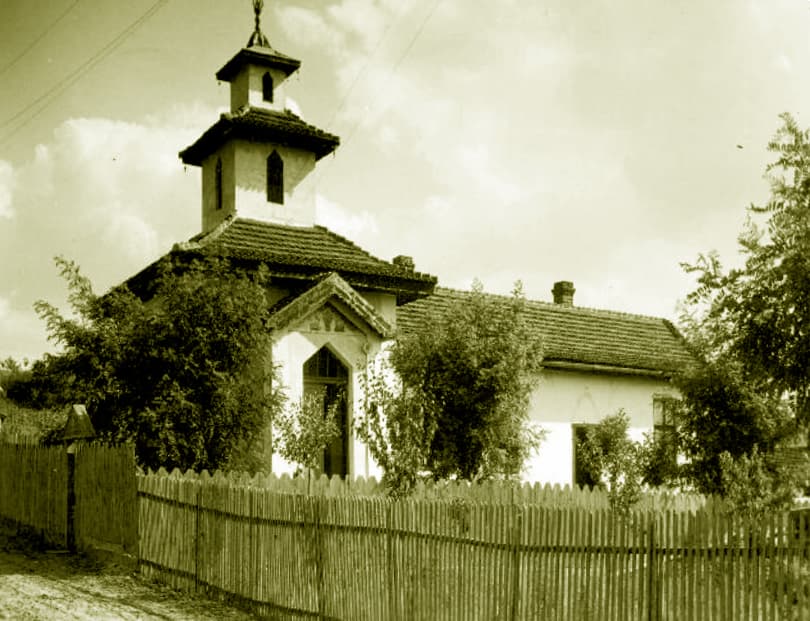
Their needs were modest, with one of the most important being the establishment of an active Buddhist temple. This request was partially fulfilled with the support of King Alexander I Karađorđević. With assistance from Serbian industrialist Miloš Jaćimović, who provided both land and construction materials, the building of the temple began. In 1929, the Buddhist pagoda was completed and became operational.
Soon after its construction, the temple became one of Belgrade’s landmarks. The 1930 Guide to Belgrade included an entry on the temple, and already the following year the street in which it was located was renamed Buddhist Street (today Budvanska Street). A Buddhist Spiritual Council was established within the temple, serving as a link for the local Kalmyk community. During major Buddhist holidays, Kalmyks from other parts of Serbia would also gather there. Connections were established with the British Maha Bodhi Society and other similar organizations. The temple hosted classes in the Kalmyk language and Buddhist religious instruction.
Six months after the consecration of the Buddha statue, Belgrade Buddhists held a memorial service for King Alexander, who had been assassinated during an official visit to France. In 1935, the temple was renovated and expanded by an additional 38 m². The Kalmyks also had their own football club, named “Janguar.”
However, World War II and its aftermath had a devastating impact on the Kalmyk community and its heritage in Belgrade. Under wartime conditions and changing political circumstances, the community was displaced and gradually disappeared from the city. During the battles for the liberation of Belgrade, the upper part of the Kalmyk temple was partially destroyed.
After the war, the new authorities considered that the Belgrade Buddhist temple had lost its purpose, as it was left without worshippers and relics. In 1950, the temple’s dome was demolished, and the ground floor was converted into a cultural center. Later, the building housed the premises of the Socialist Alliance of the Working People. Eventually, it was taken over by the company “Budućnost,” (Future) which completely demolished the structure and built a two-story building on its foundations, housing its “Hlađenje” (Cooling) service.
Today, there is no longer a Kalmyk community or Buddhist temple in Belgrade. Actor Steven Seagal announced during a visit to Belgrade a few years ago that, if the foundations of the former Kalmyk temple still exist, he would initiate a fundraising campaign for its reconstruction, in order for Serbia to have a place for the “study of ancient Eastern philosophy.” However, no concrete steps have been taken in this regard to date. Today, only memories and a few archival photographs remain as testimony to the time when Belgrade had a thriving Buddhist community.