
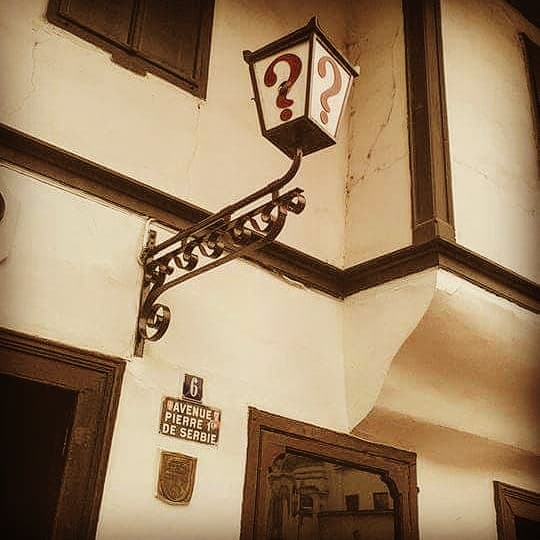
The Strange Story Behind Belgrade's Question Mark Tavern (?)
Belgrade is a city of legendary kafanas - traditional Serbian taverns that have witnessed centuries of celebrations, political debates, business deals, and everyday life. Many of them have changed names over time, following the fortunes of their owners. Yet one has remained unforgettable. Standing proudly on King Peter Street, the Question Mark (?) Tavern is the oldest active tavern in Belgrade and undoubtedly the one with the most unusual name.
Its story begins in 1823, when the building was constructed by the merchant Naum Ičko with the support of Prince Miloš Obrenović, the ruler of the Principality of Serbia. Although Ičko lived in the house, it was not his property - it belonged to Prince Miloš. After Naum Ičko's death, the building was granted to his relative, Hećim Toma Kostić, a physician who had served during the Second Serbian Uprising (1815–1817). In recognition of his service to both the uprising and Prince Miloš himself, he received the building as a gift.
It was Hećim Toma - hećim being the Turkish word for "doctor"—who transformed the ground floor into a tavern. The establishment was originally called Srpska kafana ("Serbian Tavern"), but locals soon began referring to it as Tomina kafana ("Toma's Tavern"), after its owner. As the years passed and ownership changed hands, so did the tavern's name. According to tradition, every new proprietor renamed the establishment to bring good fortune in business. At various times it was known as Kod pastira ("At the Shepherd") and later Kod Saborne crkve ("At the Cathedral Church"), reflecting its location directly opposite Belgrade's main Orthodox cathedral.
This is where the story takes an unexpected turn.
The clergy strongly objected to the tavern bearing the name of the church, arguing that a place serving food and alcohol should not be associated with a sacred institution. Faced with the considerable influence of the Church in 19th-century Serbia, the owner at the time, Ivan Pavlović, agreed to remove the controversial sign.
The problem, however, was finding a replacement.
In 1892, Belgrade already had around 300 taverns, each with its own distinctive name. After spending a sleepless night trying to think of something original, Pavlović gave up. In an act of frustration - and perhaps a touch of irony - he simply placed a question mark (?) above the entrance, inviting anyone who could come up with a better name to suggest one.
No one ever did.
The temporary solution became permanent, and for more than a century the tavern has proudly carried the name Question Mark (?), making it one of the most recognizable landmarks in Belgrade.
Since 1946, the building has been protected by law as a cultural monument. It must continue to function as a tavern while preserving its authentic 19th-century appearance, meaning that only maintenance and conservation work is permitted. As a result, it remains one of the oldest preserved buildings in Belgrade and one of the finest surviving examples of Balkan-Oriental architecture in the city.
Like many traditional urban houses of its time, the building has two floors. The ground floor served as the public space, where business was conducted and people gathered to socialize, while the upper floor was reserved for family life. In buildings of this type, the lower level commonly housed shops, workshops, markets - or, as in this case, a tavern.
One particularly fascinating detail concerns smoking. For many years, this was the only tavern in Belgrade where smoking was prohibited. The ban was introduced by Knez Miloš Obrenović out of respect for the nearby cathedral. Although the restriction was eventually lifted, traces of that later era remain visible today. Look up, and you'll notice the tavern's blackened ceiling, stained by decades of tobacco smoke.
Today, the Question Mark Tavern remains much more than a historical monument. It is a living piece of Belgrade's heritage, where visitors can still enjoy traditional Serbian cuisine and authentic local drinks in an atmosphere that has changed remarkably little over the last two centuries. Whether you stop by for a cup of traditional Turkish-style coffee served the old Oriental way, or raise a glass of rakija, the iconic fruit brandy of the Balkans, you'll be experiencing a place where history is not confined to museum displays - it is still very much alive.