
From Conflict to Ceremony: How Belgrade Ended Ottoman Military Rule
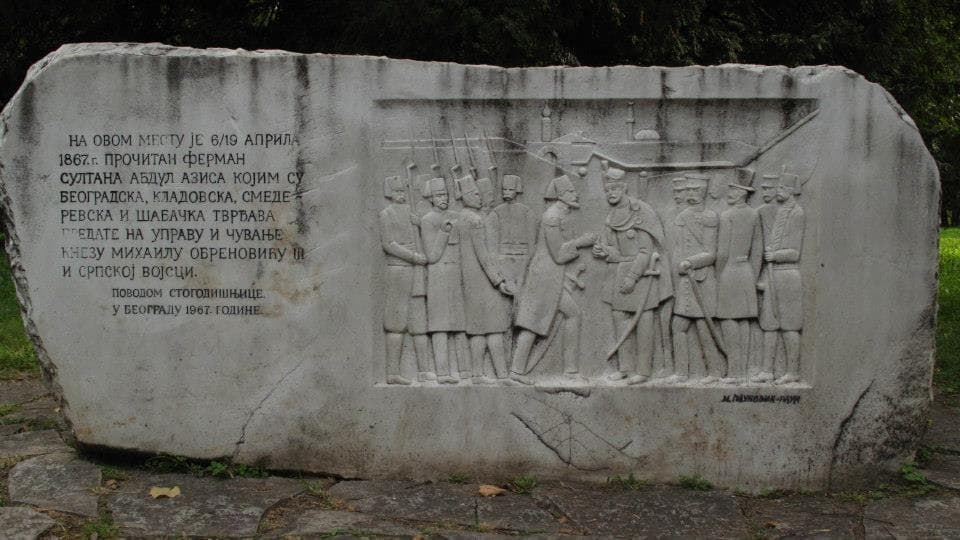
On this day, April 19, 1867, the Ottoman army withdrew from the Belgrade Fortress. This marked a significant moment - the end of 346 years of Ottoman rule over the city of Belgrade (though not continuous).
Historical Background: Rising Tensions in Belgrade
To understand the importance of this event, it is necessary to look at some of the earlier developments that led up to it. One of the most important was the Čukur Fountain incident in Belgrade. Although the urban area of Belgrade was under Serbian administration, Ottoman soldiers frequently came down from the fortress, and these visits were often far from peaceful. Numerous incidents of violence, including fights, killings, assaults, and theft, had already taken place, and tensions were high.
The Čukur Fountain Incident (June 15, 1862)
On a hot summer day, June 15, 1862, a crowd had gathered at the Čukur Fountain. Because the water flow was weak, people had to wait a long time to fill their containers. Ottoman soldiers also arrived and attempted to cut in line. This angered the crowd, and a quarrel broke out. During the argument, an Ottoman soldier took a water jug from a Serbian boy, Sava Petković, and struck him on the head with it, killing him. The soldier was then arrested by the Serbian police.
While being escorted through a narrow street between the Turkish and Serbian police headquarters, the soldier attempted to escape. Sima Nešić and a gendarme, Đorđe Nišlija, tried to stop him. At that moment, Turkish soldiers opened fire from their police building, killing both men instantly and wounding several Serbian policemen.
This incident alarmed the surrounding area and quickly spread throughout the town. As night fell, shooting erupted along the trench line and near the city gates, which the Turks had closed. Particularly heavy fighting took place at the Great Market (today’s University Park). Turkish forces occupied their police headquarters, while Serbian forces took positions in Captain Miša’s Mansion, which was still under construction. During the night, the Serbs destroyed all outer city gates except the Stambol Gate. Turkish forces from Teftedar Street (today’s Vuka Karadžić Street) retreated to the Teftedar Mosque, where they resisted until their leader, Tabak Ibrahim, was killed.
From the fortress on Kalemegdan, the Ottomans sent reinforcements to support their troops in the town. The president of the Serbian government, Ilija Garašanin, demanded that the unit withdraw. The Ottoman commander agreed but requested guarantees. Serbian Interior Minister Nikola Hristić then sent Lieutenant Ivko Prokić with a platoon of gendarmes to escort the soldiers back. However, near the city gate, the Ottomans opened fire, killing Lieutenant Prokić and several gendarmes. Despite casualties on both sides, the main objective was achieved—the Ottoman forces were pushed back into the fortress, and a larger massacre was avoided.
Truce, Funerals, and Renewed Bombardment
The following day, June 4, a truce was arranged through the mediation of the Great Powers. On June 5, a funeral was held for Sima Nešić and Lieutenant Ivko Prokić. As the procession passed through the city, cannons suddenly thundered from the fortress. The people scattered, and the coffins with the dead remained in the middle of the street. This bombardment continued from 9 a.m. until 4 p.m.
It seemed that the matter had been settled after the armistice was signed. Suddenly, on June 17th at 9 a.m., the Turks began bombarding the Serbian quarter from the fortress at Kalemegdan, to the complete surprise of the citizens. The bombardment lasted a full five hours, fired from 56 fortress cannons. On that occasion, 50 people were killed, 20 wounded, and around 380 houses were destroyed or damaged.
Mobilization and Refugees
Prince Mihailo proclaimed a state of war in Belgrade, where about 15,000 soldiers gathered in the following days, including a Bulgarian unit formed to create a command cadre for a future Bulgarian uprising. Great unrest spread throughout the country, as people awaited a solution and a way out of the situation.
On the same day, steamships arrived from Zemun to take in refugees, and asylum was granted to all regardless of national or religious affiliation. At that time, Zemun became filled with a large number of refugees.
Diplomatic Resolution: Kanlıca Conference (1862)
A larger-scale armed conflict was prevented by the intervention of the Great Powers, which, in July 1862, convened an international conference in Kanlıca near Constantinople to resolve the Serbian–Turkish dispute. After lengthy negotiations, the conference reached the following decision: that the Turks should withdraw from Serbia, except from Belgrade, Šabac, Smederevo, and Kladovo; that the fortified towns of Soko and Užice should be demolished; and that the Serbian government should pay compensation to the Turks for the property they abandoned in Serbia. Based on this decision, by the end of 1863 the Turks had withdrawn from all of Serbia except Mali Zvornik and Sakar on the Drina, as well as the aforementioned fortified towns.
Ceremony of April 19, 1867
To know how festive that day was, we will borrow a great description from the book "Journey to Constantinople", by Zorica Janković.
In 1867, shortly before 10 a.m., “the Serbian and Turkish armies were drawn up on the town field located between the town and the fortified city. Present were all diplomatic representatives in Serbia, Metropolitan Mihailo, the commander of the Belgrade Fortress Ali Riza Pasha with his staff, national delegates from across the country, and all prominent Serbian politicians.
Keeping to the program schedule, the Prince appeared exactly at 10 o’clock on a white horse, wearing an archducal (general’s) parade uniform: a red coat with white trousers, a tricorn hat with a large plume. He was accompanied in parade formation by a mounted guard and one infantry platoon. Loudly greeted by the gathered people and by both armies (Serbian and Turkish), the Prince then ascended the ceremonial platform, where he was received by Ali Riza Pasha, who bowed deeply.
According to the program, the imperial farman was first read in Turkish, and then Dimitrije Joksić, the Prince’s secretary, read the farman in Serbian translation. After the reading, as a sign of greeting and triumph, 21 Serbian cannon shots were fired. Then, in front of the flag of the assembled Turkish battalion, Ali Riza Pasha handed to Prince Mihailo, on a red velvet cushion trimmed with a golden cord, the keys of the remaining fortresses.
Upon receiving the keys, the Prince joyfully raised them high so that all present could see them, and at that moment the music began to play the popular national march “This is the threshold of dear Serbian lands.” As prescribed by the farman, the Serbian state flag (the tricolor) was then raised on the city ramparts alongside the Turkish flag (with the crescent and star).
The ceremony ended with the ceremonial entry of Prince Mihailo (on a white Arabian horse he had received from the Sultan) and one rifle company (to take over guard duty) into what had until then been a Turkish fortress. Taking the place of the former Turkish guard, the first Serbian sentry removed his cap and crossed himself.
The Prince’s return to the court was memorable. At the front rode side by side the Prince’s first adjutant and a Turkish senior officer, followed behind them in two rows by infantry officers, Serbian and Turkish. The ceremonial carriage, in which the Prince sat with Prime Minister Ilija Garašanin, was carried more by the enthusiastic crowd than pulled by the four Arabian horses. Behind the carriage rode side by side Minister of War Blaznavac and Ali Riza Pasha. At the end of the procession, the Serbian and Turkish armies played music alternately.
Belgrade and all of Serbia celebrated that day and the following three days the great success achieved by diplomatic means rather than by war.”
Final Withdrawal and Full Independence
However, this did not mean that only Belgrade was abandoned by the Ottomans. It marked the withdrawal of Ottoman military garrisons from Kladovo, Šabac, Smederevo, Užice, and Soko Grad as well. This was the moment when Serbia was effectively freed from Ottoman military presence on its territory and gained full internal independence.
Still, the process of national liberation was not complete. The Ottoman Empire remained present in the Balkans and continued to control the southern regions of what is today Serbia.
Precisely because these southern areas were not yet liberated - and because Serbia also laid claim to the territory of present-day North Macedonia, which it referred to as “Old Serbia” due to its connection with the medieval Serbian state - the monument to Prince Mihailo Obrenović was designed symbolically. The statue depicts him with his right arm outstretched, pointing toward the south - both in the direction from which the Ottoman forces were expected to withdraw and toward the still-occupied lands.
The full liberation of these territories came later, in 1912, following the First Balkan War - but that is another story...
Related Tours
Tale of the City
Essential tour of the center of Belgrade for history, culture and lifestyle.
Tale of the Modern City
Tour focusing on the modernization, rise and fall of the Yugoslavia, and establishment of modern Serbia.
Tale of Orient in Belgrade
Tour of Ottoman rule in the Belgrade, and their impact in culture and everyday life of the Serbian people.